
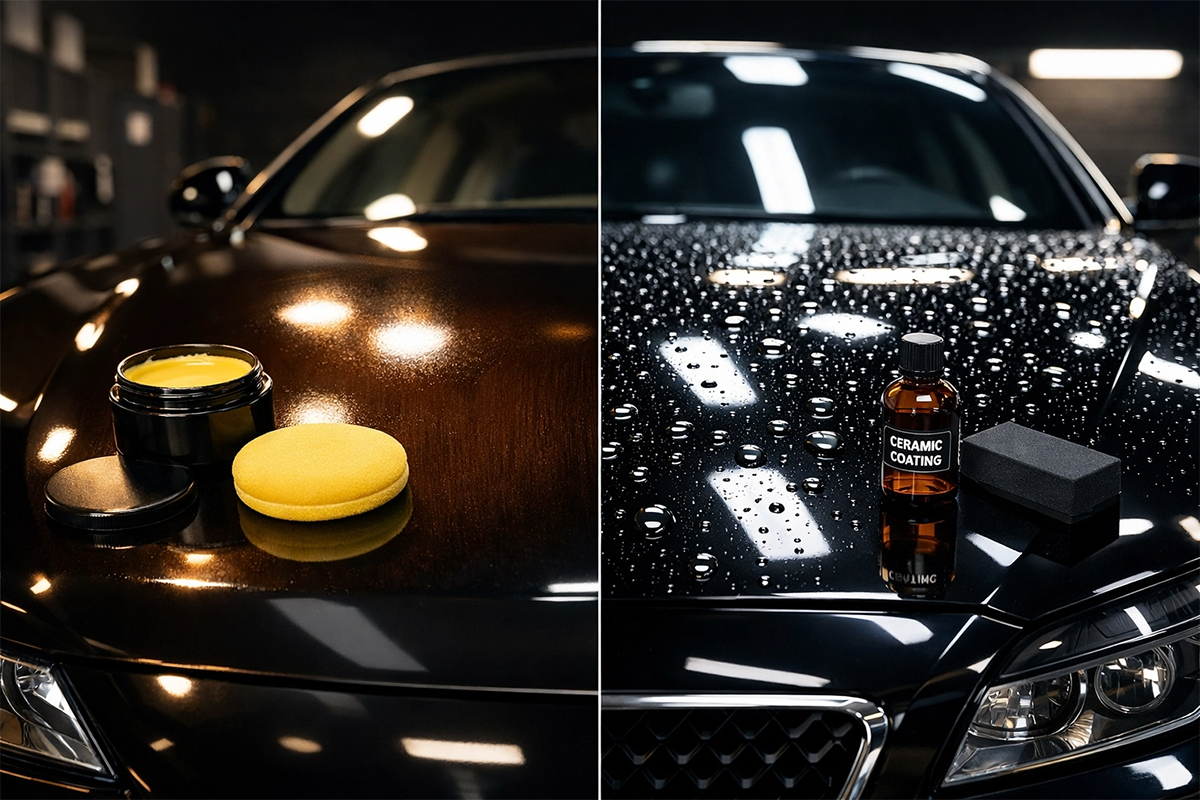
Ceramic Coating
vs Traditional Wax:
Which Is Right for You?

Choosing the right paint protection is one of the most impactful decisions you’ll make as a car owner. Get it right and your paint stays sharp, clean, and protected for years. Get it wrong and you’re either reapplying wax every few months or dealing with a botched ceramic coating that took your paint down with it.
We’ve applied both on hundreds of vehicles here in Wilkes County. Here’s everything we know.
Understanding Traditional Wax
Traditional car wax has been the standard paint protection method for decades. Made from natural carnauba or synthetic polymers, it creates a sacrificial barrier between your paint and the elements — UV rays, water, light contaminants, and road grime.
How Traditional Wax Works
Wax sits on top of your paint’s clear coat — it doesn’t bond to it chemically. It fills microscopic surface imperfections, creates a smooth reflective layer, and delivers the warm, deep glow that carnauba is famous for. Because it’s sacrificial, it wears away over time and needs reapplication every 4–12 weeks depending on conditions.
✅ Pros of Wax
- Affordable — $15 to $50 per application
- Beginner-friendly, forgiving process
- Warm, natural-looking carnauba glow
- Easy to apply and remove
- Can be layered for added depth
- Wide variety of products available
- Flexible — easy to switch products
❌ Cons of Wax
- Short durability — 1 to 3 months
- Requires frequent reapplication
- Minimal chemical resistance
- Breaks down in heat and UV
- Less hydrophobic than ceramic
- No meaningful scratch resistance
- Ongoing time and cost commitment
Understanding Ceramic Coating
Ceramic coating is a liquid polymer — typically silicon dioxide (SiO2) — that chemically bonds to your paint’s clear coat at a molecular level. Once cured, it forms a hard, glass-like shell that’s dramatically more durable than any wax product on the market.
How Ceramic Coating Works
Unlike wax, ceramic doesn’t sit on top of the paint — it becomes part of the surface. The coating fills the microscopic pores in your clear coat and cross-links into an extremely hard, hydrophobic layer. Water, dirt, road grime, bird droppings, and UV radiation all hit the ceramic layer first — not your paint.
✅ Pros of Ceramic
- Long-lasting — 2 to 5+ years
- Superior chemical resistance
- Excellent hydrophobic water sheeting
- Moderate to high scratch resistance
- UV protection prevents oxidation
- Self-cleaning effect — less maintenance
- Deep, wet-look gloss that lasts
- One application, years of protection
❌ Cons of Ceramic
- Higher upfront cost ($499–$2,000+)
- Requires thorough paint correction first
- Difficult application — mistakes are permanent
- 24–48 hour cure time, no water contact
- Won’t hide or fix existing paint defects
- Professional application recommended
- Removal requires machine polishing
Head-to-Head Comparison
| Feature | 🫧 Traditional Wax | 🛡️ Ceramic Coating |
|---|---|---|
| Durability | 1–3 months | 2–5+ years |
| Upfront Cost | $15–$50 | $499–$2,000+ |
| Application Difficulty | Easy — beginner friendly | Difficult — experience required |
| Hydrophobic Effect | Good — water beading | Excellent — water sheeting |
| Chemical Resistance | Low to moderate | High |
| Scratch Resistance | Minimal | Moderate to high |
| Gloss Type | Warm, natural glow | Deep, wet-look shine |
| UV Protection | Moderate | Excellent |
| Ongoing Maintenance | Reapply every 4–12 weeks | Minimal — occasional topper |
| Removal | Easy — washes off | Difficult — requires polishing |
| Best For | Beginners, garaged vehicles | Daily drivers, harsh climates |
Which One Should You Choose?
Neither option is universally better — the right choice depends on your situation. Here’s how to think about it clearly.
🫧 Choose Traditional Wax If…
- You’re new to detailing and still learning
- You have a limited budget right now
- You enjoy the ritual of regular waxing
- Your vehicle is garaged and low-exposure
- You prefer a warm, natural carnauba finish
- You want flexibility to change products often
- You’re preparing to sell the vehicle soon
🛡️ Choose Ceramic Coating If…
- You want years of protection, not months
- Your vehicle sits outside in the elements daily
- You’re willing to invest in proper paint prep
- You want maximum hydrophobic water sheeting
- You prefer a deep, glossy wet-look finish
- You want minimal maintenance going forward
- You have a new or high-value vehicle to protect
The Hybrid Approach
Many professional detailers — including our team — recommend a hybrid strategy: apply a ceramic coating as your base, then maintain it with a spray ceramic topper or ceramic-infused spray wax. This gives you the best of both worlds.
💡 The Hybrid Method
- Ceramic base coat — applied once, lasts years
- Ceramic spray booster — applied every 3–6 months after washing
- Extends the base coating’s lifespan significantly
- Adds an extra sacrificial layer between washing
- Maintains that deep wet-look gloss year-round
Application Step by Step
Applying Traditional Wax
Applying Ceramic Coating
💡 Pro Tip
If you’re not ready to commit to a full ceramic coating, start with a quality synthetic sealant or spray ceramic. These mid-tier options give you 6–12 months of enhanced protection, stronger hydrophobics than carnauba wax, and a much more forgiving application process. They’re the perfect stepping stone.
Final Thoughts
Both ceramic coating and traditional wax earn their place in a proper detailing routine. Wax is an accessible, affordable, and rewarding way to protect and maintain your paint — especially if you enjoy the process. Ceramic coating is the premium long-term solution for anyone who wants serious protection with minimal ongoing effort.
The one thing both have in common: preparation matters more than the product. A properly prepared surface with a basic wax will always outperform a ceramic coating applied over contaminated, unpolished paint. Start clean, stay consistent, and your vehicle will show it.
Need help deciding what’s right for your specific vehicle? Call or reach out to us — we’re happy to talk it through.
Want a Pro to Handle It?
We apply ceramic coatings, paint sealants, and full details right here in Wilkes County, NC. Mobile service available. Call for a straight, honest quote.


